




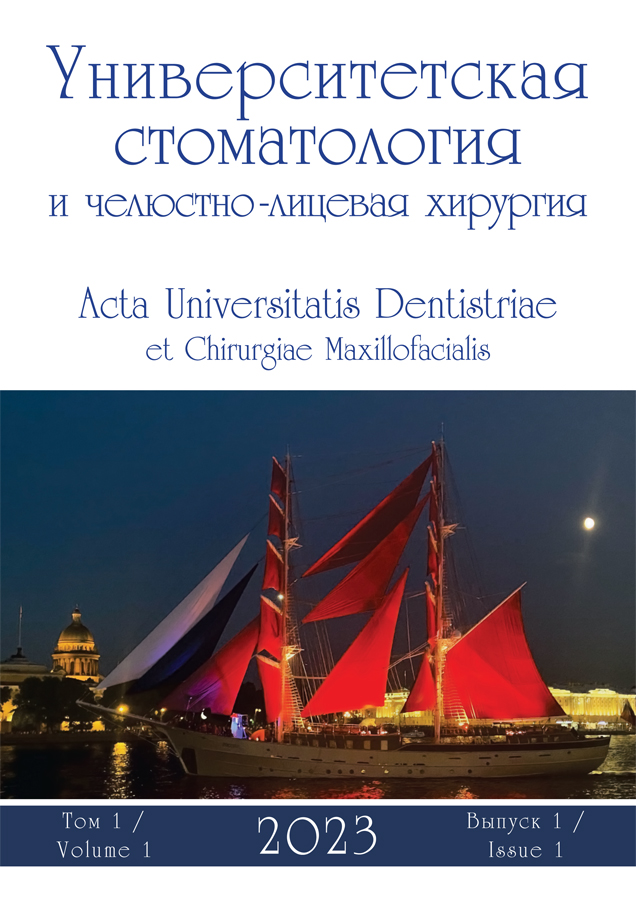
Acta Universitatis Dentistriae et Chirurgiae Maxillofacialis
Peer-review medical journal.
Editor-in-chief
- Prof. Roman Fadeev, MD, PhD
Publisher
- Eco-Vector (Saint Petersburg, Russia)
Journal founders
- North-Western State Medical University named after I. I. Mechnikov
WEB: https://szgmu.ru/eng/ - Eco-vector Publishing Group (Saint Petersburg, Russia)
WEB: https://eco-vector.com/
About
The journal «Acta Universitatis Dentistriae et Chirurgiae Maxillofacialis» was created in 2022 at the Department of Orthopedic Dentistry, Orthodontics and Gnathology, North-Western State Medical University named after I. I. Mechnikov. The founder and editor-in-chief of the journal is Professor, Doctor of Medical Sciences, Head of the Department Fadeev Roman Aleksandrovich.
Sections
- Reviews
- Clinical dentistry and maxillofacial surgery
- Scientific research
- Publications of young scientists
- Information about scientific conferences
Publications
- quarterly, 4 issues per year
- russian and english articles and full-texts
Distribution
- Open Access, under the Creative Commons Attribution-NonCommercial-NoDerivatives 4.0 International License (CC BY-NC-ND 4.0)
Current Issue
Vol 1, No 1 (2023)
- Year: 2023
- Articles: 8
- URL: https://stomuniver.ru/unistom/issue/view/7657
- DOI: https://doi.org/10.17816/UDS.11

Scientific research
The effectiveness of caries prevention in patients with enamel defects of noncarious origin at the stages of orthodontic treatment
Abstract
BACKGROUND: White spot caries around braces is a common complication of orthodontic treatment. Numerous studies have indicated varying levels of the effectiveness of preventive measures for patients with braces, particularly for patients with noncarious enamel defects.
AIM: This study aimed to determine the effectiveness of the use of preventive agents around braces and in the area of noncarious spots in patients with enamel defects at the stages of orthodontic treatment.
MATERIALS AND METHODS: The study involved 54 patients aged 14–18 years. All patients were divided into three groups. In group 1, patients were treated monthly with the area around the bracket and the spot with Fluorine-Lux for deep fluoridation. In group 2, the enamel around the braces was fluoridated monthly with Fluorine-Lux varnish. Patients used R.O.C.S. toothpaste for home hygiene (ProBrackets&Ortho). In group 3 (control group), patients received professional oral care twice a year according to the standard regimen. Patients used fluoride toothpaste for oral care at home. Treatment lasted no more than 25 months. The initial levels of hygiene, caries intensity, and enamel resistance in all groups were comparable.
RESULTS: After removing the bracket system, the intensity of the caries in group 1 significantly increased slightly to 13.75 ± 1.12 (p > 0.01), and the “K” component increased to 2.91 ± 0.38 (p > 0.01). After removing the orthodontic equipment, the intensity of the carious process in group 2 was 12.23 ± 1.34, with highly significant differences (p < 0.05), the “K” component was 3.42 ± 0.19 (p < 0.05), and the number of teeth with noncarious defects was 4.19 ± 0.06 (p < 0.05). The appearance of new carious spots and cavity defects in teeth with noncarious enamel lesions that require treatment and filling were recorded. In group 3, the intensity of dental caries after the removal of the orthodontic equipment was 18.21 ± 0.16, with highly significant differences (p < 0.05), the “K” component was 6.83 ± 0.11 (p < 0.05), and the number of teeth with noncarious defects was 1.98 ± 0.04 (p < 0.05). The appearance of new carious spots and cavity defects in teeth with noncarious enamel lesions requiring treatment and filling were registered.
CONCLUSIONS: To prevent caries in the form of white spots on the teeth in patients with noncarious lesions during orthodontic treatment, professional oral hygiene monthly with the removal of the arch wire is recommended. The most effective is the combination of home oral hygiene using calcium-containing paste and monthly application of the drug Fluorine-Lux for deep fluoridation around braces and in noncarious areas.
 7-14
7-14


Reviews
Review of modern methods of diagnosis and treatment of snoring and obstructive sleep apnea syndrome
Abstract
This study aimed to provide an overview of the diagnostic methods and treatments for snoring and obstructive sleep apnea syndrome. The average incidence of snoring is 40% among men and 20% among women aged 30–60 years. The average incidence of obstructive sleep apnea syndrome is 4% among men and 2% among women. These data are close to the incidence of diabetes and are twice as high as that of severe bronchial asthma. Currently, approximately 1 billion people have obstructive sleep apnea syndrome. The average incidence rates of snoring and obstructive sleep apnea among children are 27% and 1.2%–5.7%, respectively, with peak incidence recorded at the age of 2–8 years because of the hypertrophy of the tonsils and adenoids. In this study, modern diagnostic methods and treatments for snoring and obstructive sleep apnea syndrome are considered. A complex approach to patient treatment justified.
15-22
Clinical dentistry and maxillofacial surgery
Clinical experience of using occlusocorrectors as an operational positioner
Abstract
The article presents the clinical experience of using composite occlusorrectors for the purpose of surgical positioning of the mandible during its osteotomy, which minimizes inaccuracies in jaw closure, ensures proper closure of teeth, in some cases — to facilitate oral hygiene, as well as to prevent the syndrome of forced position of the mandible in the postoperative period, thereby reducing the prerequisites for recurrence of maxillary-facial anomalies.
23-28
Influence of the conditionality of maxillofacial anomalies on the choice of orthodontic treatment tactics
Abstract
The article examines the dependence of the orthodontic treatment tactics on the conditionality of the maxillofacial anomaly. Thus, in the presence of identical-sounding diagnoses and even similar degrees of severity of signs of maxillofacial abnormalities, the recommended treatment plans may differ significantly. In some cases, the distal ratio of dentition in patients with complete growth can be adjusted using the Herbst apparatus, in cases of resorption of the articular head of the mandible and concomitant facial asymmetry, hardware-surgical treatment may be preferable.
29-36
Clinical case of prosthetic prostheses for an edentular upper jaw with implant support
Abstract
The article shows the possibilities of temporary and permanent prosthetics of the edentulous upper jaw supported by implants and presents the clinical and laboratory stages of temporary and permanent prosthetics with a fixed structure supported by implants.
37-44
History
45-50
Персоналии
51-54
55-62

Регистрационный номер и дата принятия решения о регистрации сетевого издания: ЭЛ № ФС 77 - 85457 от 13.06.2023.